Tuesday, September 24, 2013

Principle of Relative Human Efficiency (Reason #324 why Evolution is false)

The scientists that are attempting to replicate evolutionary processes are dozens, even hundreds of *orders of magnitude* more efficient than undirected natural processes. If we can split the atom and eradicate smallpox, we should be able to produce multiple examples of a biological transformation that is purported to be as common as evolution.

Or at the very least, we should have been able to see it. If we can detect black holes and isotopes with a half life of less than one millionth of a second, then we surely should be able to observe something that has (according to the theory) happened billions of times.

Monday, September 23, 2013

Why Evolution is Completely False


The two tenets of evolution are Darwinism and common descent.
A. The only scientifically accepted mechanism of evolution, Darwinism, is mathematically impossible. Only some form of continuous intelligent intervention can account for the forms we see.
B. DNA only affects the proportions and characteristics of a creature's structure, but the structure itself is also partly derived from the process of generation, such as the egg and sperm. However, DNA is the only thing we know of that passes on genetic information. Consequently, major structural changes can't be passed on to later generations.  Therefore, different species cannot have a common ancestor.
So, if the structural changes necessary to change species can't be passed on, and constant intervention is required anyways, there isn't any compelling reason to believe in common descent. I know of no empirical evidence that necessitates common descent, everything I know of is much better explained in terms of the artifacts of engineering.
Thus, I conclude both major tenets of evolution to be false: Darwinism and common descent. Therefore, evolution as a whole is false.

Friday, April 26, 2013

Intelligent Agents Are Immortal

One surprising implication of Intelligent Design theory is that intelligent agents must be immortal.

First, let's define immortality.  Immortality is not the same as indestructible.  Something may be immortal, but still capable of being taken out of existence.  What immortality means is that the thing will not decay and cease to exist through the normal course of events.

Now, many are probably familiar with the famous syllogism: "All men are mortal.  Socrates is a man.  Therefore, Socrates is mortal."  What is it that makes men mortal?  It is that our human bodies decay, and eventually reach the point where they no longer function.  It is quite clear that through the normal course of events human bodies are mortal.

However, let's say we have an intelligent agent with a physical body.  Just because the physical body decays does not mean the intelligent agent is mortal.  Why do I state this?  The question to ask is: is an intelligent agent identical to its body?  If not, then the destruction of the body does not necessarily entail the destruction of the agent.

So, is the agent identical to its body?  Intelligent Design theory states this is not the case.  All intelligent agents are distinguished by their ability to create CSI.  But, necessity and chance cannot create CSI.  The physical body is a mechanism of necessity and chance, and consequently cannot create CSI.  Since the agent can create CSI and its body cannot, the agent is clearly not identical to its body as it is capable of something the body cannot do.

Furthermore, the agent cannot be a result of the body.  Just as the body cannot itself create CSI, it cannot create something else that creates CSI, as it would then be creating CSI indirectly.  So, if the agent, being a creator of CSI, therefore does not come from the body, then removing the body does not remove the source of the agent.  Consequently, whatever the agent is is not subject to the same decay the body undergoes.

If the process of decay is what makes the body mortal, and the agent is not subject to the process of decay, the agent cannot be mortal.  Therefore, intelligent agents are immortal.

Monday, March 18, 2013

You are not your brain

Imagine someone makes an exact replica of your brain.  Now there are two physical instances of your brain in existence with the exact same inputs and outputs.  Which one is you?  Why, the original of course.

Therefore, you are not your brain.

How can Google hire charlatan Kurzweil?!?


In response to:

Why Ray Kurzweil’s theory about how the human mind works is not better than the others, and, ...  in fairness, no worse.

Let me start off by saying I'm surprised someone of Kurzweil's caliber doesn't know about the No Free Lunch Theorem and its implications!

Regardless of whether he's a materialist or not, he should know the NFLT proves all AI algorithms are equivalent, and there's nothing special about his particular idea.

If Kurzweil has read Russell and Norvig's "AI: A Modern Approach", which is THE AI textbook (and is written by the director of research at the company where he works!!!) Kurzweil would know all AI is search and representation.  The whole point of the NFLT is that it proves there is no one best search algorithm, they are all exactly equivalent over all problem domains.  It doesn't matter what philosophy he happens to believe, he could be materialist, substance dualist, Unicornitarian, Gnomist, whatever.  The only contribution he can make is to say what what particular problem domain his AI algorithm happens to be good in.

This is not an ideological or philosophical issue.  The NFLT is mathematically proven, recognized by all computer scientists, and he should know a fundamental result in his own field of expertise!  This is a supposed computer science genius who doesn't know basic graduate computer science!

I can't believe Google hired this charlatan!

At least PZ Myers gets it right for once:

P.Z. Myers calls Kurzweil “one of the greatest hucksters of the age.” Furthermore, Professor Myers has said he’s "completely baffled by Kurzweil's popularity, and in particular the respect he gets in some circles, since his claims simply do not hold up to even casually critical examination."

Clearly Google needs a witch doctor for their religion of transhumanism!

The Singularity, says Professor Myers, is “a New Age spiritualism—that's all it is. Even geeks want to find God somewhere, and Kurzweil provides it for them." 

But Google's newly hired director of engineering isn't laughing.  He's serious (im)mortally so.  "I find death unacceptable,"  says Mr. Kurzweil. "Natural selection isn't significant anymore.  Technological change is the cutting edge of evolution."

As the wise GKC once said:

"When people stop believing in God, they don't believe in nothing — they believe in anything."

Monday, November 12, 2012

Is Vitalism an alternative explanation to Intelligent Design?

Dr. Nagel's claims that while ID effectively shows the inadequacy of chance and necessity to explain biological organisms and processes, intelligent agency is not the only alternative and is less preferable to a more unitive principle.  Dr. Barham extends this argument with a few examples based around the more ancient notion of vitalism.

http://www.thebestschools.org/bestschoolsblog/2012/11/12/nagel-dembski-life-mind/

Vitalism does seem to be one implication of ID based science, as shown by Dr. Wells and Dr. Sternberg.  For example, in the case of fetal development, claiming that the entire developmental process is the product of God's continuous direct intervention seems equivalent to saying the same about the operation of all physical processes - since such an intervention can explain everything it would explain nothing.  Furthermore, since the fetus is not conscious for a significant portion of development, the development can't be attributed to the fetus' conscious activity.

Additionally, Dr. Sternberg has shown the information necessary for the fetal development cannot be contained within the original sperm and egg.  Therefore, some external source of developmental information is necessary.  I'm not sure if Dr. Sternberg has ruled out the fetus' environment, but my impression is he did not think the physical matter involved in the fetus' development could account for the necessary developmental information.

So, if neither fetus nor environment can account for its development there must be a non-physical source of information that develops the fetus, which begins to look a lot like Aristotlian vitalism, and does not need direct intelligent agency to explain its operation.

However, this does not solve the information problem, it merely pushes the problem up a level, and Dr. Dembski's design inference argument is just as applicable.  Again, the question must be asked where does the information of the non-physical vital process come from?  What is needed is an information creator.

Wednesday, September 5, 2012

Materialism and human rights


Recently an MIT researcher argued robots may gain legal rights:

The arguments for why this could and should be done revolve around anthropomorphism and proper conduct.  Such arguments do not in fact support robots having rights, but are more similar to laws we have now against media that portray, and allow people to engage in certain acts that would be atrocious if real.  In this case, we are not giving rights to fictional characters by outlawing such products.

However, from a materialistic point of view, extending rights to robots does make sense.  Within materialism, humans are essentially very complex robots, and by giving rights to humans we are already giving rights to robots.  There is little difference giving rights to robots produced by evolution and giving rights to robots produced by these robots.

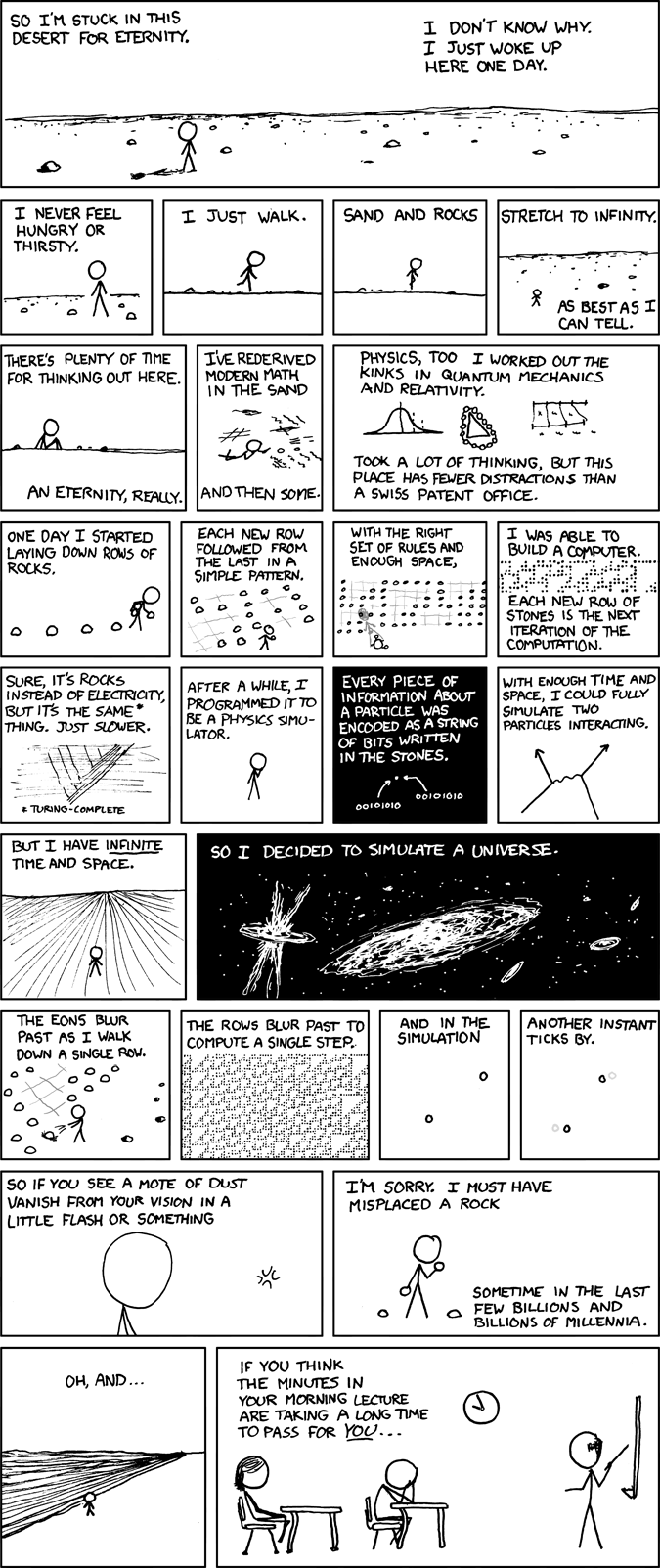
Rights do not stop at robots, though.  A robot is essentially software hooked up to a set of actuators and sensors.  Software can be embedded in many different media, besides silicon and circuitry.  For example, rocks in a desert can be a computer: http://xkcd.com/505/

Consequently, robotic software can be embedded in this rock computer, turning the desert into a robot, and thus conferring rights to the desert.

In short, pretty much any physical object can end up getting rights within materialism.  So next time your computer locks up and you start beating it with your keyboard, careful or it might take you to court!

The question remains, if materialism is not the answer for giving a robust and coherent account of human rights, what can?  Well, Intelligent Design points us in the right direction:
http://appliedintelligentdesign.blogspot.com/2011/10/human-dignity.html